
What Is the Lifespan of a Gnome?

Gnomes have an incredibly long lifespan, typically living between 350 to 400 years. You'll find that they reach adulthood around 40, middle age at 100, and are considered old at 150. By 200, gnomes enter their venerable years, with some reaching a maximum age of 500. Their longevity is attributed to their unique biology and innate magical nature. Gnomes continue reproducing until about 100 years old, and elderly gnomes are highly respected for their vast knowledge. Different gnome subraces may have slight variations in lifespan, but all enjoy centuries of life. Exploring the stages of a gnome's life reveals fascinating perspectives into their culture and society.
Gnome Lifespan Overview
Throughout the domains of fantasy, gnomes stand out as one of the longest-lived races. These diminutive beings can live anywhere from 350 to 400 years, far surpassing the lifespan of most other humanoid creatures. To put this into perspective, gnomes reach middle age at around 100 years old, a point at which many humans have already completed their life's expedition.
In Dungeons & Dragons 3.5 edition, gnomes are considered old at 150 years and venerable at 200. Their maximum age is determined by adding 200 years to a roll of 3d% (three 100-sided dice), potentially allowing some gnomes to live well over 400 years. This extended lifespan considerably impacts how gnomes experience life and reach various stages of maturity compared to shorter-lived races like humans.
While humans typically reach adulthood in their late teens, gnomes have a much slower developmental process. This prolonged youth and extended lifespan affect how gnomes approach life, relationships, and personal growth. Their longevity allows them to accumulate vast amounts of knowledge and experience, often making them abundant sources of wisdom in their communities.
Stages of Gnome Life
The stages of a gnome's life span centuries, each phase lasting far longer than those of shorter-lived races. Gnomes can live an impressive 350-400 years, with their lifecycle divided into distinct periods. Deeply rooted in garden traditions spanning centuries and cultures, gnomes are known for their longevity, allowing them to witness multiple generations of shorter-lived races throughout their extended lifetime.
While the exact timeline for childhood and adolescence isn't clear, you'll find that gnomes are expected to settle into adult life by around age 40. This is typically when they start having children, beginning their odyssey as parents. Gnomes average a middle age of 100 years, marking the midpoint of their extensive lifespan.
As gnomes approach their later years, they're considered old at 150 years. At this stage, they've likely accumulated vast experience and wisdom. It's worth noting that gnomes might stop reproducing around 100 years old due to increased risks of unhealthy offspring.
In D&D 3.5e, gnomes reach venerable status at 200 years, with a maximum age of 200 plus 3d% years. This means some exceptionally long-lived gnomes could potentially reach 400 years or more.
Factors Affecting Gnome Longevity

Several factors contribute to the impressive longevity of gnomes, setting them apart from shorter-lived races. Unlike humans who reach adulthood in their late teens, gnomes live much longer, with their middle age starting at 100 years. You'll find that gnomes might live up to 350-400 years, with some exceptional individuals potentially reaching five centuries. Gnomes have been part of Swedish stories for centuries, and their extended lifespan allows them to accumulate vast amounts of knowledge and experience, making them esteemed members of their communities well into their later years.
Gnomes' unique biology plays a significant role in their extended lifespan. They start having children around age 40 and typically stop reproducing by 100 due to health concerns. This reproductive timeline aligns with their slower maturation process, as gnomes are expected to settle into adult life by around age 40.
Their love for knowledge and craftsmanship also contributes to their longevity. Gnomes love to engage in activities like Craft (alchemy), which may have life-extending properties. Additionally, many gnomes live underground, which could protect them from harsh environmental factors that might shorten lifespans.
Gnome Maturity and Adulthood
Understanding gnome maturity and adulthood can be tricky, as the shift isn't as clearly defined as it is for humans. While gnomes mature at a similar rate to humans, they're generally considered adults around age 40. This is when they typically begin having children, marking a significant milestone in their lifespan.
You'll find that gnomes continue to reproduce until about 100 years old, giving them a lengthy period of fertility compared to humans. However, the exact timeline of gnome physical and mental maturity remains unclear, especially in the current edition of Dungeons & Dragons. The progression from childhood to adulthood and later into old age isn't well-defined, leaving room for interpretation in your games or stories.
It's worth noting that previous editions of the game provided more detailed information on gnome maturity stages, but these may not fully apply to modern interpretations. As you consider a gnome's lifespan and development, keep in mind that more specific current information on the different stages of gnome maturity would be helpful for a clearer understanding of their life cycle.
Elderly Gnomes in Society
Many gnomes reach their elderly years around 150, with those over 200 considered venerable. In gnomish culture, these elderly individuals are highly respected for their vast knowledge and experience. Unlike humans, gnomes maintain sharp mental faculties well into old age, making them precious resources for their communities.
As gnomes age, they often take on mentorship roles, passing down their skills and traditions to gnome children and those who've recently reached adulthood. This is particularly important for forest gnomes, who rely on the wisdom of their elders to preserve their unique connection with nature and illusion magic. Elderly gnomes may struggle with diminishing physical capabilities, but their caster level often increases with age, allowing them to perform more powerful magic.
Gnomes over 300 years old are extremely rare and command great respect in their societies. Despite their advanced age, these individuals often maintain their characteristic sense of humor and zest for life. They serve as living repositories of gnomish history and lore, ensuring that their culture's traditions and knowledge are preserved for future generations.
Gnome Subraces and Lifespans
Within the diverse world of gnomes, different subraces exhibit varying lifespans. Rock gnomes, the most common subrace, and svirfneblin (deep gnomes) share similar longevity, typically living between 350 and 400 years. You'll find that forest gnomes, the smallest of the subraces, have a slightly shorter lifespan, usually ranging from 300 to 350 years.
Despite these differences, all gnome subraces follow a similar aging pattern. You'll be considered middle-aged at 100 years old, regardless of your subrace. By the time you reach 200, you'll be viewed as venerable in gnome society.
It's worth noting that while these are average lifespans, some gnomes have been known to plunge, navigate, and uncover longer lifespans. The maximum documented lifespan for a gnome is an impressive 500 years, though this is exceptionally rare. As you journey through the world of gnomes, you'll observe that their long lives contribute immensely to their accumulated knowledge, skills, and cultural richness. Each subrace's lifespan influences their outlook on life and their role within gnome communities.
Magical Influences on Longevity

The extraordinary longevity of gnomes isn't just a quirk of their biology; it's deeply rooted in their magical nature. You'll find that gnomes possess an innate magic affinity, allowing them to live 350 to 400 years on average. This connection to arcane energies permeates their bodies and minds, granting them a significant racial bonus to longevity.
As you explore deeper into gnome society, you'll discover their mastery of illusion spells and their ties to the fey sphere play essential roles in their extended lifespans. These magical influences enable gnomes to outlive humans by more than three times. Some gnome subraces, like the svirfneblin or deep gnomes, exhibit even greater magic resistance, further prolonging their lives.
You'll notice that gnomes have a comprehensive understanding of the arcane forces governing their existence. This knowledge allows them to wield magic to extend their lives even further. Through the use of magic items and their natural magical abilities, gnomes can actively influence their longevity. Their deep connection to magic isn't just a tool; it's an integral part of their life-extending capabilities.
Comparing Gnome and Human Lifespans
When you compare gnome and human lifespans, you'll find a stark contrast that shapes their respective cultures and worldviews. Gnomes can live an astonishing 350-400 years, far surpassing the human lifespan. This longevity is reflected in their maturity timeline, with gnomes reaching adulthood around age 40, while humans typically do so in their late teens.
In D&D 3.5e, gnomes are considered middle-aged at 100, old at 150, and venerable at 200 years. Some gnomes can even live beyond 300 years, thanks to the game's maximum age calculation. This extended lifespan significantly influences gnome society and culture, affecting their approach to life, relationships, and personal growth.
The vast difference in lifespans also impacts how gnomes view adventuring. With centuries ahead of them, gnomes may be more inclined to take risks, investigate the world, and pursue long-term goals. Their expansive perspective allows them to witness historical changes and accumulate knowledge over generations, shaping their unique outlook on life and their place in the world.
Cultural Implications of Long Lives
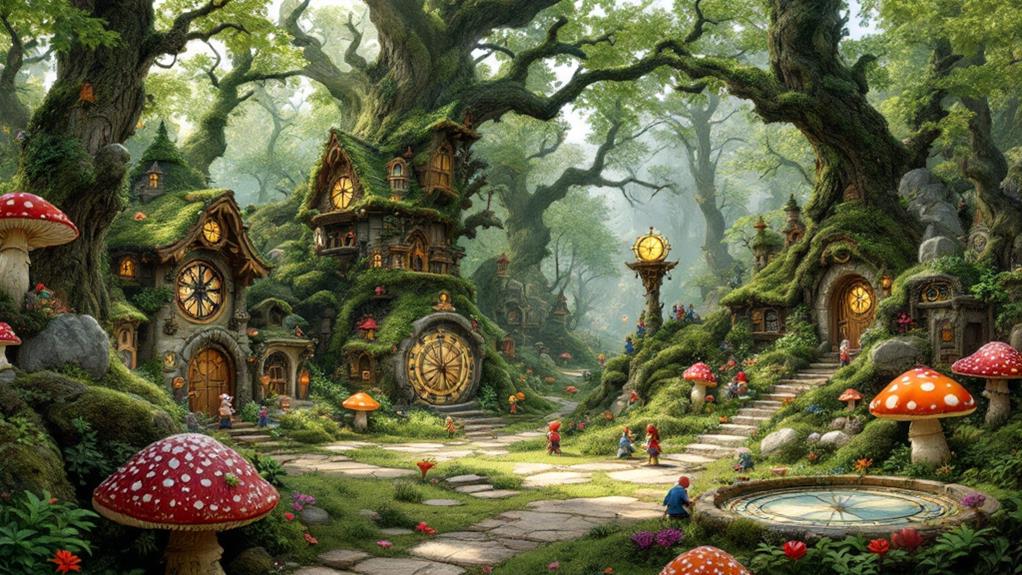
Over the course of their extended lives, gnomes develop a unique cultural fabric that's deeply influenced by their longevity. Their 350-400 year lifespan allows them to accumulate vast knowledge and skills, shaping their societies in significant ways. You'll notice that gnome communities are characterized by:
- Patience and adaptability in the face of change
- A focus on long-term projects and gradual progress
- Strong familial bonds that span generations
- Preservation and evolution of rich cultural traditions
Gnomes' extended lifespans encourage a sense of patience and adaptability, as they're able to weather social and political changes over centuries. This longevity enables them to pursue long-term projects and invest in their communities' gradual progress. You'll find that gnomes often have a reputation for eccentricity, as they have more time to indulge in quirks and hobbies throughout their lives. Their long lives mean they often outlive other races, leading to deep familial bonds and a strong emphasis on preserving cultural traditions. As a result, gnome societies are rich with accumulated wisdom, intricate customs, and a unique viewpoint on time that sets them apart from shorter-lived races.