Global Disco Craze: How Disco Music Was Reimagined Around the World
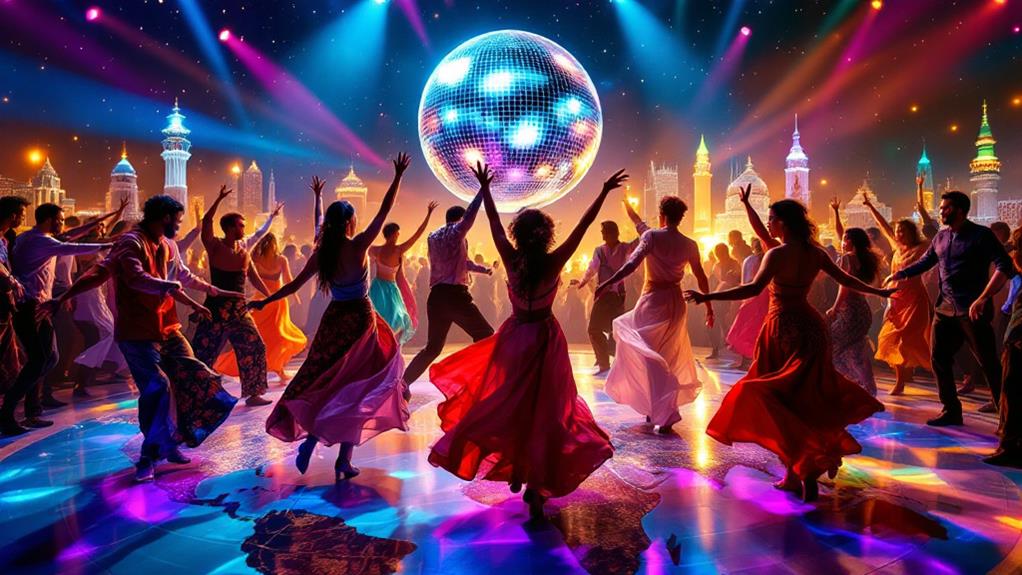
Disco's infectious beats spread far beyond American borders, sparking a global craze in the late 1970s. You'd find unique interpretations worldwide, from Europe's Eurodisco and Italo disco to Latin America's Salsoul fusion. In Asia, genres like Japan's Eurobeat and India's classical-infused disco emerged. Africa birthed Afrobeat and Soukous, while the Middle East blended disco with traditional Arabic sounds. Even Australia immersed itself in disco fever. Each region incorporated local musical traditions, creating diverse subgenres that celebrated cultural heritage while embracing the global trend. Disco's ability to transcend boundaries and inspire reimagination contributed to its lasting impact on dance music culture.
Disco's Journey Beyond American Borders
The dance floor became a global stage as disco fever spread beyond American borders. You'd find the infectious beats and glittery aesthetic of disco music pulsing through clubs from Tokyo to Berlin. As it traveled, disco's influence ignited new forms of expression in local music scenes worldwide.
In Europe, you'd encounter disco's transformation into Euro disco and Italo disco, blending electronic elements with the genre's signature four-on-the-floor rhythm. Underground clubs in London and Paris embraced disco's roots in gay culture, creating safe spaces for marginalized communities to express themselves freely. Miami's rich musical heritage of Caribbean music laid the foundation for the city's lively Latin music scene, which also contributed to disco's global spread.
As you ventured to South America, you'd uncover how disco merged with local rhythms, giving birth to genres like Brazilian disco and Disco Samba. In Africa, the influence of disco helped shape the evolution of genres like Soukous and Makossa.
Even in countries where Western music was restricted, disco found its way into the cultural fabric. You'd see its impact on Soviet-era estrada music and the underground disco scenes that emerged in countries like China and Iran.
European Disco Renaissance
As disco's global trek continued, Europe became a hotbed for the genre's evolution. You'd find that in the late 1970s, Eurodisco and Italo disco emerged, pushing the boundaries of the American disco sound. These new styles incorporated more electronic instrumentation and production techniques, laying the groundwork for what would become electronic dance music.
Giorgio Moroder, a pioneer of Eurodisco, revolutionized the genre by introducing synthesizers and drum machines. His innovations shaped the expansive and futuristic Europop disco sound. Meanwhile, Italo disco, born in Italy, a key founding location of the Memphis Group, fused electronic elements with the melodic sensibilities of American disco. Artists like Donna Summer and Cerrone exemplified this unique blend.
You'd notice distinct local styles developing in European disco scenes across France, Germany, and the United Kingdom. These variations reflected cultural differences while still drawing inspiration from American disco. The global popularity of Eurodisco and Italo disco in the late 1970s and early 1980s played an indispensable role in spreading disco's influence beyond its American roots, creating a true European disco renaissance.
Latin America's Disco Fever
Latin America's disco fever burned hot and bright, sweeping across the continent with infectious energy. By the late 1970s, disco music had taken root in countries like Brazil, Argentina, and Mexico, altering the popular music arena. You'd find discotheques and dance clubs in major cities becoming lively hubs of disco culture, attracting diverse crowds keen to celebrate self-expression.
The history of disco in Latin America isn't just about importing New York City's sound. It's a story of reimagination and fusion. Influential artists like Héctor Lavoe, Willie Colón, and Celia Cruz incorporated disco elements into traditional Latin genres, creating exciting new hybrids. This blend of Latin rhythms and disco's pulsating beats gave rise to subgenres like Salsoul, which gained global recognition in the music industry.
Disco's emphasis on inclusivity resonated strongly with Latin American youth, making it a cultural phenomenon. On dance floors across the region, you'd witness a celebration of liberation and self-expression. The disco craze in Latin America wasn't just about adopting a foreign trend; it was about embracing and transforming it, creating a unique and lasting impact on the continent's musical landscape.
Asian Interpretations of Disco
While Latin America welcomed and altered disco, Asia's interpretation of the genre took on its own unique flavor. You'd be amazed at how disco music underwent change across the continent, blending with local sounds and traditions.
In Japan, you'd find a fascinating mix of disco, Enka ballads, and electronic music, giving birth to Eurobeat and Shuukyoku-kei genres. It's as if David Mancuso's legendary disco dance floor had been transported to Tokyo and given a distinctly Japanese twist.
South Korea's Trot genre emerged from the disco era, fusing Korean folk with disco rhythms. Meanwhile, India adopted disco songs with a classical touch, as exemplified by Nazia Hassan's hit "Disco Deewane."
Southeast Asian countries like the Philippines and Indonesia created their own disco-infused styles, incorporating local musical elements. As discos opened across the region, the genre became a cultural phenomenon, sparking major dance competitions and festivals.
Unlike the disco backlash seen in some Western countries, Asia's love for the genre endured. The gay community, in particular, found expression and acceptance through these Asian interpretations of disco, much like their counterparts did with original disco records in the West.
African Disco Rhythms
From the heart of Africa emerged an energetic and unique interpretation of disco that would enthrall audiences worldwide. You'll find that African-influenced disco music pulsated with high-energy rhythms, polyrhythmic percussion, and call-and-response vocal styles, creating an irresistible sound that got people moving.
Fela Kuti's Afrobeat style led the charge, blending Nigerian highlife, funk, and jazz influences to forge a distinctive African disco sound. This fusion sparked a musical revolution across the continent, with local adaptations springing up in countries like Nigeria, Senegal, and Zimbabwe.
In South Africa, artists like Yvonne Chaka Chaka and Brenda Fassie popularized their own take on disco in the 1980s, infusing it with regional flavors. Meanwhile, Soukous, a Central African dance genre, left its mark on uptempo disco tracks with its signature guitar riffs and percussion patterns.
As you investigate African disco, you'll uncover how it became a unifying force across the continent. Each region contributed its unique elements, resulting in a rich mosaic of sounds that celebrated African heritage while embracing the global disco phenomenon.
Disco in the Middle East
As disco fever swept across the globe, it found fertile ground in the lively cities of the Middle East. In the late 1970s, you'd have witnessed the transformation of the region's music scene as iconic artists like Fairuz and Wadih El Safi began infusing disco elements into their traditional Arabic compositions.
You'd have felt the pulsating rhythms in the active clubs and discotheques of Beirut, Cairo, and Tehran, where Western influences merged seamlessly with local musical traditions. Arabic disco hits, such as Fairuz's "Ahibba Ahibba," became dance floor staples, captivating both local and international audiences.
What set Middle Eastern disco apart was its unique fusion of disco beats with traditional instruments. You'd have heard the enchanting sounds of the oud, saz, and tabla blending with disco's signature four-on-the-floor rhythm, creating a hybrid sound that appealed to the region's youth.
The emergence of Italo disco in the 1980s further cemented disco's influence in the Middle East. With its Middle Eastern-inspired melodies and rhythms, Italo disco became a cultural bridge, showcasing the global appeal and adaptability of the genre.
Oceania's Disco Scene
Across the vast expanse of the Pacific, Oceania welcomed the disco craze with open arms. You'd find Australia at the forefront of this movement, with its thriving disco scene in the 1970s. Clubs like Patches and Dynasty became the epicenters of this new cultural phenomenon, rivaling even New York's legendary venues.
While disco faced backlash in some parts of the world, culminating in events like the Disco Demolition Night, Oceania submerged into it wholeheartedly. The region put its own spin on the genre, with Australian artists like Marcia Hines and Joe Camilleri creating a unique local sound influenced by American funk and soul.
For the first time in music history, Sydney's Oxford Street emerged as the hub of Australia's gay disco scene. Venues like Tilly's Disco hosted inclusive dance parties that became integral to mainstream culture. Meanwhile, in New Zealand, Auckland's Gluepot attracted diverse crowds seeking the energetic atmosphere of disco.
The impact of "Saturday Night Fever" and international acts like the Village People and Donna Summer further fueled Oceania's love affair with disco, solidifying its place in the region's cultural tapestry.
Global Disco Fusion Movements
Blending diverse cultural influences with disco's infectious beats, global fusion movements emerged across continents, each adding its unique flavor to the genre. You'll find Eurodisco leading the charge, combining disco's rhythmic foundation with electronic elements like synthesizers and drum machines. This European take on disco plunged into progressive arrangements, setting the stage for future electronic dance music.
In Italy, you'll uncover Italo disco, which took a more robotic and futuristic sound approach compared to its American counterpart. Meanwhile, Latin American disco infused tropical instrumentation and rhythms with disco's upbeat tempo, creating a perfect fusion of salsa and four-on-the-floor structure.
Across the Pacific, J-disco emerged in Japan, adapting disco's themes of hedonism and club culture with a distinct Japanese pop sensibility. In Africa, particularly Nigeria, Ghana, and South Africa, traditional percussion and vocals merged with disco's danceable grooves, giving birth to African disco.
These global fusion movements showcased disco's versatility and universal appeal. By incorporating local musical traditions and cultural elements, each region reimagined disco, creating unique subgenres that continue to influence dance music today.